I had completely forgotten I wrote mispelr. It surfaced while I was working on PoeticalBot, which uses it to misspell poems, and there it was, a browser toy from 2015 that takes perfectly good text and ruins it.
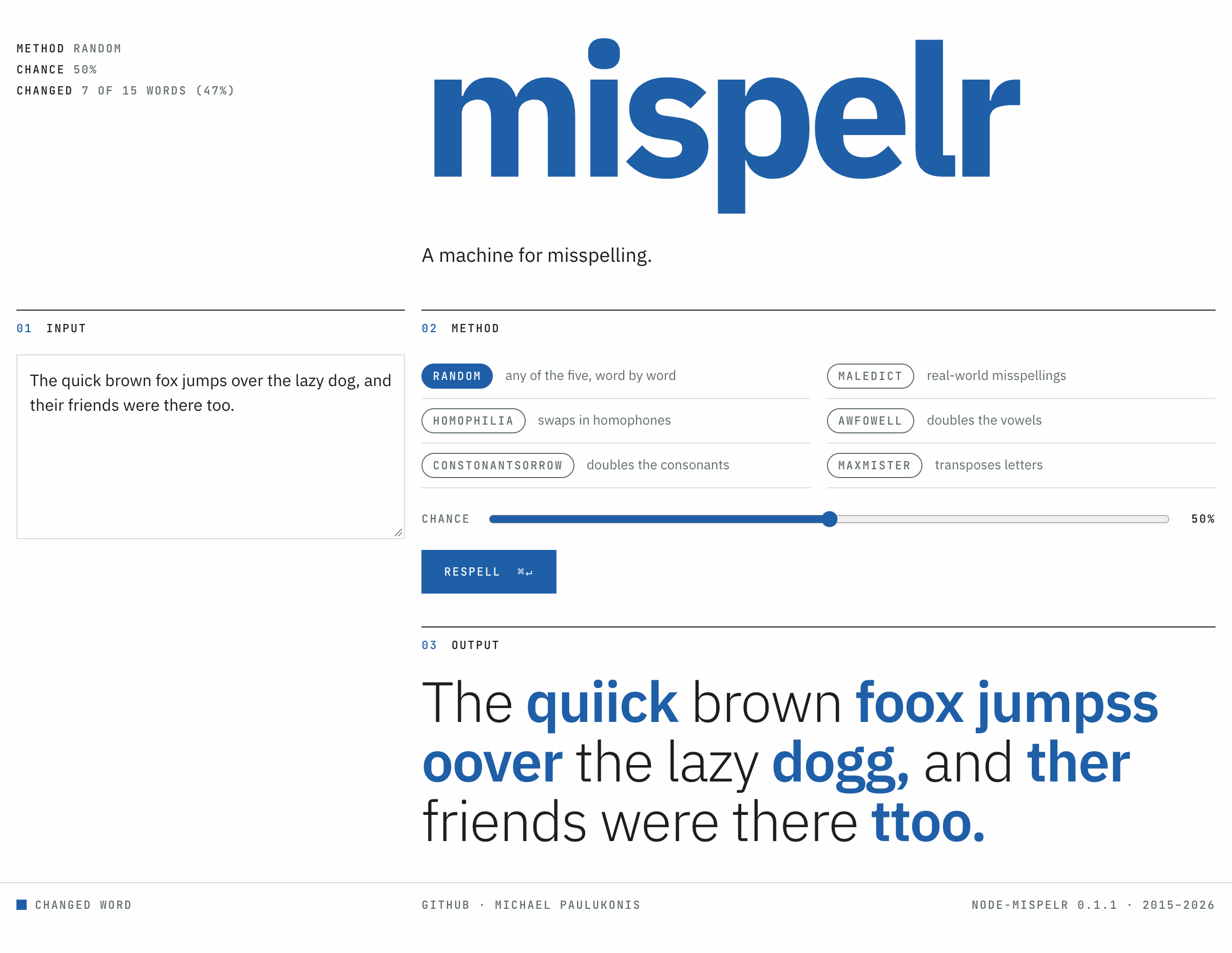
It has six ways to do the ruining:
maledictswaps in real-world misspellings from a dictionary of common typosawfowelldoubles (sometimes triples) vowelsconstonantSorrowdoes the same to consonantsmaxmistertransposes two adjacent letters, never the first ("Teh qucik bronw fxo")homophiliaswaps in homophonesrandommixes the others, word by word
It did what I wanted, but I was never completely happy with it. Every word went through the respeller once, and some came back unchanged, but how much of a sentence got mangled depended on the method and the dice and it was usually too much. There was no way to set it. And TBH, it was more annoying than anything else. Which was disappointing, since it did what I wanted. But eating a gallon of ice-cream in one go is not fun.
So I brought it back up to speed. It lives in textgen-monorepo now, next to PoeticalBot. It's on npm as node-mispelr. And the old Bootstrap page is a new playground (that's it up top).
Tuning it with percentages made a big difference. respell takes a chance option - the share of words to misspell, 0 to 1. It also takes an rng, so pass a seeded generator and the output is replayable: same seed, same text, same method, same misspelled poem. And each word's misspelling is fixed by the seed; chance only picks which ones get used. Raise it from 10% to 60% and the 10% typos are still there, with more added around them.
const seedrandom = require('seedrandom')
const text =
  'The quick brown fox jumps over the lazy dog, and their friends were there too.'

mispelr.respell(text, 'random', { rng: seedrandom('fox'), chance: 0.1 })
mispelr.respell(text, 'random', { rng: seedrandom('fox'), chance: 0.6 })
// the second keeps every misspelling from the first, and adds more
chance isn't always exact. maledict and homophilia pass through any word they don't have an entry for, and maxmister skips anything under three letters, so the remaining words make up the difference as far as they can.
Extending the README also turned up a bug that had been sitting in the data for eleven years. A few rows in the homophone list were written as prose - there,their,and they're, to,too,and two - and the conversion script kept the "and". So homophilia turned "their" into "and they're". I'd seen it in the playground but not chased it. Generating examples from real seeded output put it right in front of me. Fixed in 0.1.1.
- Playground: https://michaelpaulukonis.github.io/mispelr/
- npm: node-mispelr
- Source: textgen-monorepo/libs/mispelr